
Loading…
Loading…
How ERPNext runs an asset from purchase to retirement on one record — capitalisation, depreciation schedules, repairs, movement and disposal — and where the accounting stays honest.
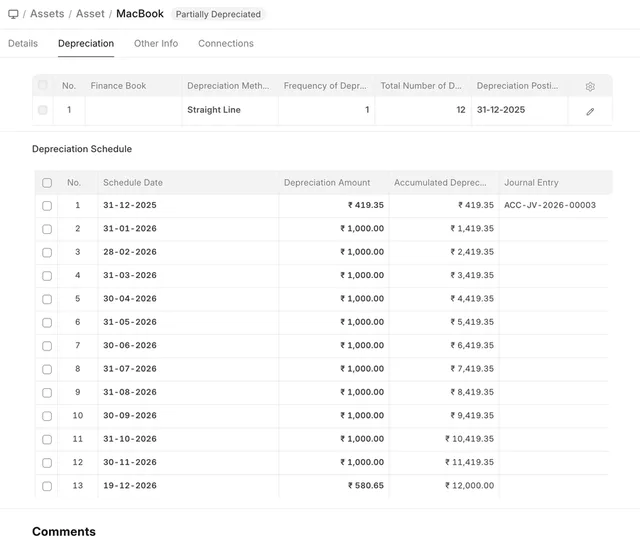
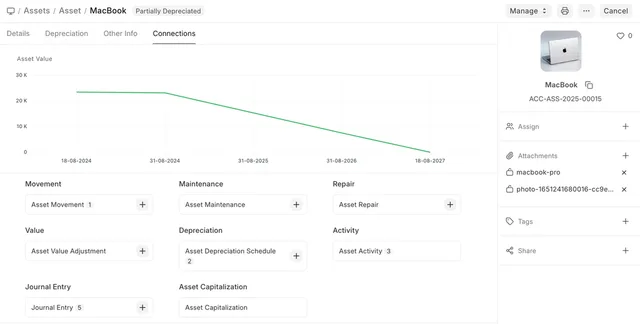
Every plant, vehicle, laptop and machine your business owns has a life — it's bought and capitalised, it depreciates, it gets repaired and moved, and eventually it's scrapped or sold. In most Indian businesses that life is tracked across a fixed-asset register in Excel, a maintenance log somewhere else, and a set of manual depreciation journals the auditor untangles once a year. ERPNext replaces all of that with a single Asset record that carries the whole story: how it was capitalised, its depreciation schedule, every repair and movement, any revaluation, and its final disposal. This paper walks the full lifecycle grounded in the real doctypes — Asset, Asset Depreciation Schedule, Asset Capitalization, Asset Repair, Asset Movement, Asset Value Adjustment and the shift-based depreciation engine (Asset Shift Allocation and Asset Shift Factor). It explains what the software automates, what still needs discipline, and where an experienced partner earns their keep — so your register, your depreciation and your books are one source of truth rather than three that never quite agree.
The complete paper — every section, in a clean branded PDF you can share with your team. Free, no email required.
Yes — and that's the core advantage over a spreadsheet. In ERPNext every asset event (purchase capitalisation, depreciation, capitalised repairs, revaluations, scrap and sale) is a transaction against the Asset record with its own journal entry, so the fixed-asset register and the general ledger are the same data. There's nothing to reconcile at period-end, and the closing net block is backed by a document trail rather than a rebuilt sheet.
ERPNext supports Straight Line, Written Down Value, Double Declining Balance and a Manual method where it drafts the schedule and you fine-tune rows. For assets whose wear depends on usage, shift-based depreciation lets you define shift intensities as Asset Shift Factors and record the shift an asset ran in via Asset Shift Allocation, so a machine run across two or three shifts depreciates faster than one run for a single shift.
ERPNext's Finance Books let you run more than one depreciation schedule on the same asset — for example a statutory basis and a tax basis — without keeping a parallel register. ERPNext gives you a rigorous, event-driven asset ledger; aligning it precisely to Indian Companies Act versus Income Tax Act treatment is a configuration decision (and, where the rules bite, a matter for the India Compliance app and an experienced partner) worth getting right once at setup.
Disposal happens from the Asset record. To scrap, ERPNext writes off the remaining carrying value with the appropriate journal entry and marks the asset Scrapped (restorable if done in error). To sell, you raise a Sales Invoice against the asset and ERPNext computes the gain or loss as proceeds versus net book value and posts it automatically, marking the asset Sold. Because the asset's value was maintained by every event in its life, the net book value at disposal is already correct.
Get a clear plan, an honest timeline, and a fixed scope. Talk to a real expert today — whether or not you work with us.
or write to info@acube.co
Kochi (Kadavanthra & Infopark) · Thiruvananthapuram · across India & overseas · In business since 2011