
Loading…
Loading…
How ERPNext's Tax Withholding Categories deduct the right tax on the right transactions automatically — and where the India Compliance app takes over for GST TCS and return filing.
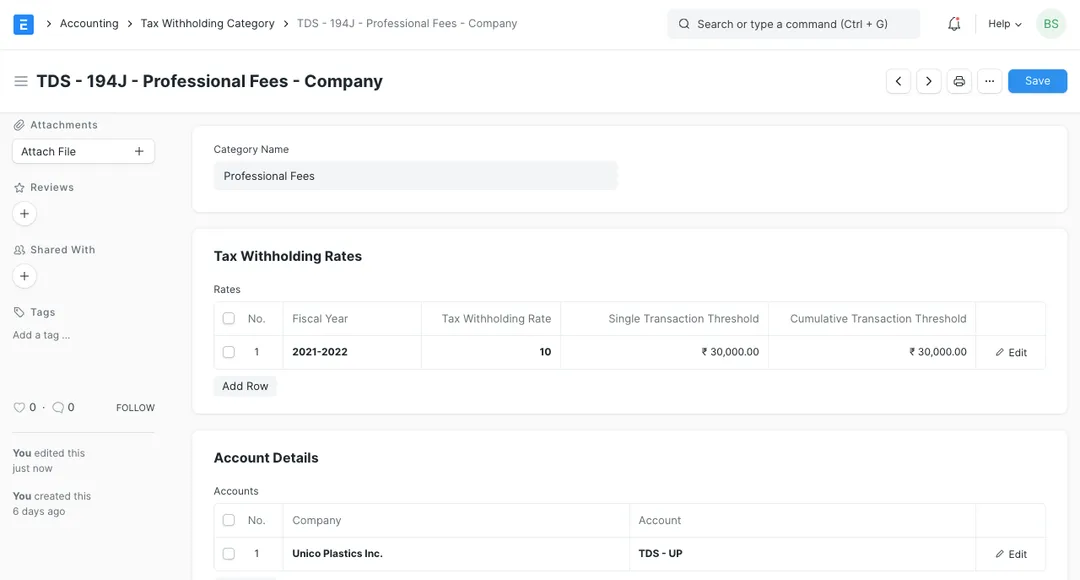
Every Indian business that pays professionals, contractors, rent or commission has to withhold tax at source — deduct TDS, deposit it, and account for it correctly. Done by hand, it is a monthly grind of rate tables, threshold checks, and reconciliations that go wrong quietly and cost you at assessment time. This paper explains how ERPNext turns that grind into configuration. Its Tax Withholding Category doctype holds the rates and thresholds; once a supplier (or customer) is linked to a category, ERPNext works out whether tax is due on each purchase invoice, payment or advance and deducts the right amount automatically — respecting both single-transaction and cumulative-across-the-year thresholds. We ground every claim in the real ERPNext doctype, then draw the line honestly: core ERPNext runs the withholding engine and its TDS reports, while the separate India Compliance app adds GST TCS and the statutory-return side of Indian compliance. The aim is to show what the software genuinely does for you, what still needs a correct setup, and where an experienced partner earns their keep.
The complete paper — every section, in a clean branded PDF you can share with your team. Free, no email required.
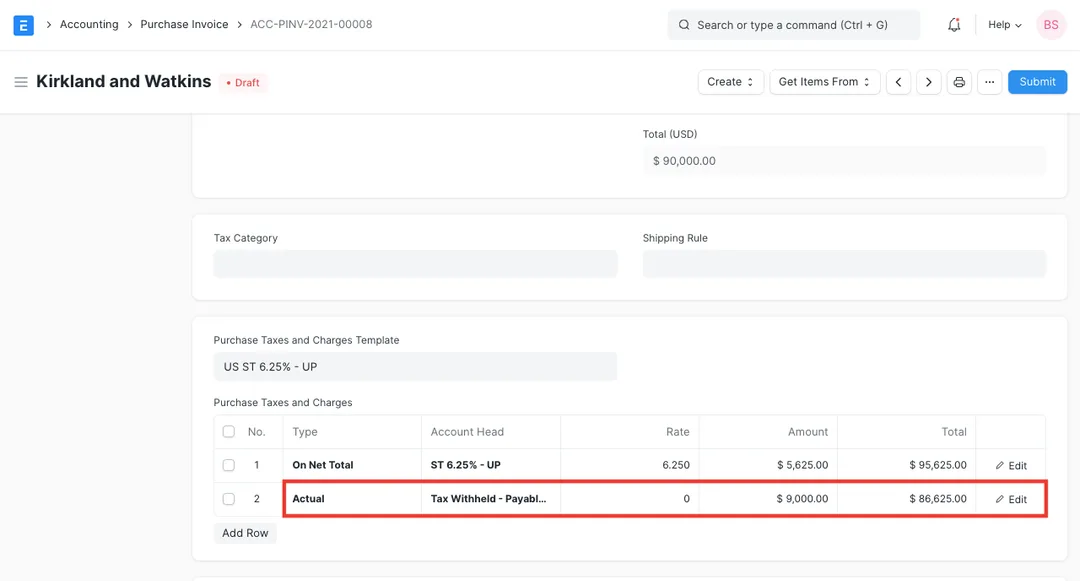
Yes. You define the rules once in a Tax Withholding Category — the rate (dated by fiscal year) and the thresholds — then link it to a supplier. From then on ERPNext evaluates each purchase invoice and payment, and when tax is due it adds the withheld amount into the invoice taxes automatically, posting to the withholding account and reducing the net payable. The deduction is a by-product of booking the transaction, not a separate manual step.
Each rate row in a Tax Withholding Category carries both a single-transaction threshold and a cumulative threshold. The single threshold asks whether one invoice, on its own, is large enough to deduct on; the cumulative threshold asks whether the year-to-date total to that party has crossed the annual limit. ERPNext keeps the running party total, so the invoice that finally crosses the cumulative line triggers deduction automatically — even if no single bill was ever large enough by itself.
Core ERPNext runs the income-tax withholding engine — TDS on what you pay, and tax collected at source on customers, via Tax Withholding Categories — along with reports like the TDS Computation Summary. GST TCS, which an e-commerce operator collects on platform supplies, is a different regime; that and the deeper Indian statutory-return side are handled by the separate, free India Compliance app, which extends ERPNext for Indian GST. They're designed to work together, but they are two distinct things.
Yes. Because TDS is often triggered at payment in India, ERPNext can apply withholding on a Payment Entry, including on advances, and reconcile it against the invoice when it arrives so the deduction isn't double-counted. Combined with invoice-time deduction and Lower Deduction Certificate support, that covers the common timing cases without a parallel manual calculation.
Get a clear plan, an honest timeline, and a fixed scope. Talk to a real expert today — whether or not you work with us.
or write to info@acube.co
Kochi (Kadavanthra & Infopark) · Thiruvananthapuram · across India & overseas · In business since 2011