
Loading…
Loading…
A till that refuses to sell a handset without its IMEI, knows which branch has the model you do not, and prices every offer the same way in every store.
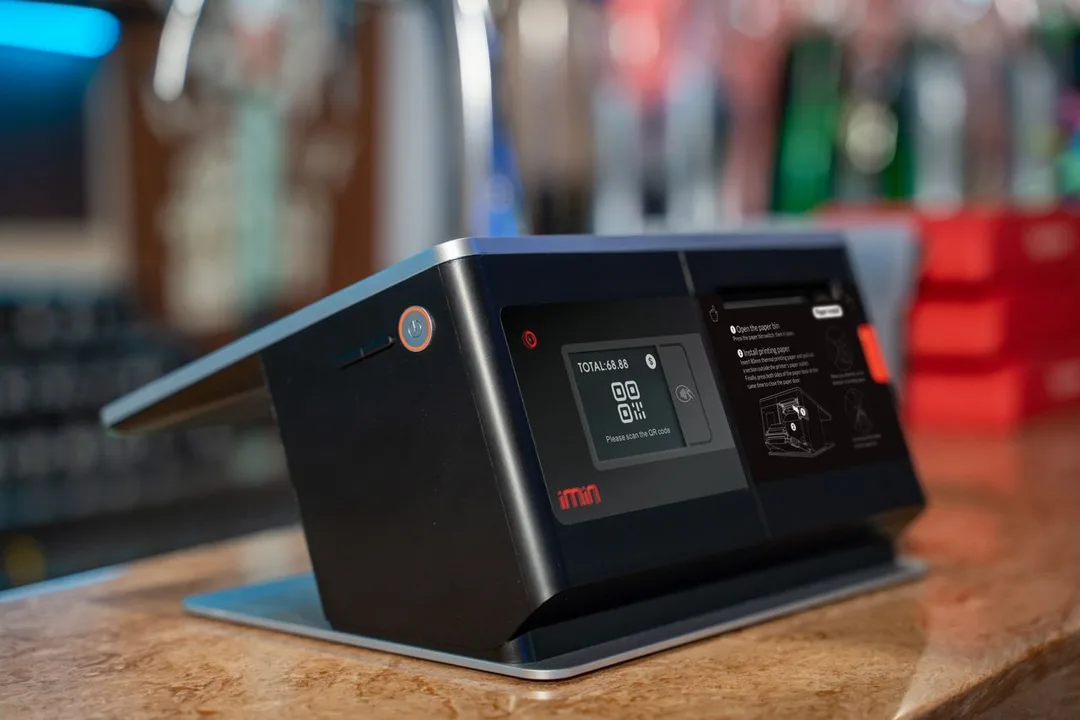
A phone shop's till has to do more than add up. It has to capture a serial number that a warranty claim will depend on two years from now. It has to know the floor price. It has to value an old handset, apply this week's offer, arrange finance, and produce a GST invoice that will survive a filing — usually while three people wait.
This is that till, built on ERPNext's POS and stock engine, with the rules a phone chain needs enforced at the point where they are cheap to enforce: before the sale completes, not in a report next month.
In business since
Clients served
ERP projects
Work by referral
The IMEI got skipped.
It was busy. Two years later a warranty claim needs it and nobody can find it.
"We don't have it."
You did — at the branch across town. The sale went to the shop next door.
A little off, to close the deal.
A few hundred rupees at a time, spreading quietly through the team.
The handset line will not complete without a scanned, validated number that matches this branch's stock.
Below the floor price the sale stops and waits for a manager — before the money is gone, not after.
Out of stock here shows who has it, and raises the transfer from the same screen.
Every handset sold is tied to a validated IMEI, on the invoice and in a register you can search two years later.
When the model is out here, the till shows which branch has it and raises the transfer from the same screen.
A floor price the till enforces, offers that apply themselves, and a campaign budget that pauses a runaway promotion.
The same grading questions every time, so two customers with the same phone get the same answer.
HSN, in-state or out-of-state, e-invoice IRN and QR, generated from the sale rather than typed after it.
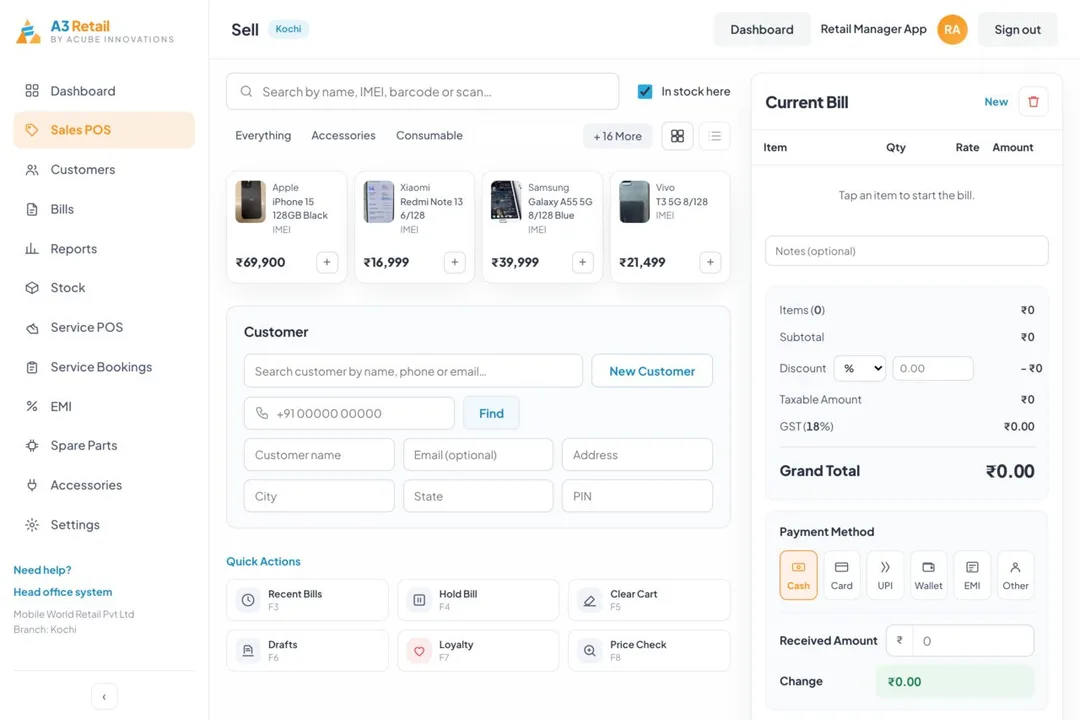
A known number fills in the name, address and their history with you. A new one is created as the name is typed — no separate customer-creation errand.
Search or tap. The tile shows this branch's stock and the selling price, so nobody promises what is not there.
For a handset the till asks, and does not proceed without it. The number is validated and matched against stock actually in this branch — scanning the box on the shelf next door does not work.
The tile says so, and shows which branch has one, with a button that raises the transfer request.
The applicable campaign shows on the line. If the price looks wrong, the offer is the first thing to check.
EMI, a trade-in against the old handset, and an extended-warranty plan are all part of the same bill rather than three separate errands.
Cash, card, UPI or a split across them. GST is applied by the invoice, and the receipt and PDF are available immediately — including a reprint later, without going to the back office.
Search by name or IMEI, the running bill with GST applied, and every payment mode on one screen.
A campaign is set up once at head office: which items or brands, which branches, what discount, over what dates, up to what total spend. It becomes real pricing rules at each branch's warehouse, so the price a customer is quoted in one store is the price they are quoted in another.
Two things stop the usual failures. Campaigns activate and expire on their own dates, so nobody has to remember to switch last month's promotion off — the single most common source of unplanned discount. And each campaign carries a budget: when the spend reaches it, the campaign pauses itself and asks for a decision rather than quietly continuing to cost you money.
Screen condition, body, battery health, accessories, whether it powers on — the same list every time, at every branch.
Not from how the day is going, and not from how much the customer is arguing.
As a used item, against a serial that keeps its original IMEI, received into the used-devices warehouse. It is real stock with a real cost, not an adjustment on the bill.
Rule 32(5): GST on the margin rather than on the full sale value, with a register to support the position at filing time.
The customer chooses a scheme, the checklist tells the counter which documents that partner needs for it, and the sale cannot be submitted until the financier has approved. Subvention — the discount you are effectively funding — is posted as a cost rather than being buried in a lower sale price, so the margin on an EMI sale is visible rather than assumed. How EMI and financier settlement work →
on a device line, validated, and checked against this branch's stock. Overriding it is an administrator's act and it is recorded.
Below the minimum selling price, the line stops and waits for a manager. The decision is made before the sale, by someone entitled to make it.
A campaign that reaches its cap pauses itself instead of running on.
Every sale carries who made it, which is what makes an incentive calculable and an argument avoidable.
| What happens | |
|---|---|
| HSN codes | At the six or eight digits the law requires, not the four-digit chapter heading |
| In-state or out-of-state | The right tax template is chosen from the parties, not by the person billing |
| E-invoice | IRN and QR generated and printed where they belong |
| Second-hand devices | Margin scheme under Rule 32(5), with its own register |
| Reverse charge | Posted as the add-and-deduct pair, so liability and input credit both appear |
| Branch books | Consolidated or branch-wise from the same ledger, by clearing a filter |
| The receipt | Thermal at the counter, PDF invoice on request, both on that branch's letterhead |
what each outlet sold, by day, category and payment mode.
which unit went to which customer, on which invoice. The one you will want under pressure.
when your shops are actually busy, which is a staffing decision more than a sales one.
value, units, attach rates and the exchange and EMI mix.
what a campaign sold against what it cost you.
trade-ins taken, and the tax position on resale.
Bring your worst billing week — we will walk through exactly where it would have gone differently.
How it runs today
How it runs on this
Answer a few plain questions about how you work.
That is the default. A device line will not complete without a scanned IMEI that passes validation and matches stock in that branch. An administrator can override for a genuinely mis-printed box, and the override is recorded against the sale.
No. It is a connected system and we would rather tell you plainly than have you find out on a Saturday evening. If connectivity at a branch is genuinely unreliable, a backup connection is the answer, and we will raise it during scoping rather than after go-live.
They are configured once centrally and pushed to each branch as real pricing rules, with their own start and end dates and a spend cap. Nobody has to remember to turn last month's promotion off.
Not without a manager. A line below the minimum selling price stops at the till and waits for approval, so the conversation happens before the sale rather than in a margin report next month.
By grading — a fixed set of questions about screen, body, battery and accessories — so the value follows from the device's condition rather than the mood of the negotiation. The used handset then enters stock under its original IMEI.
Under the margin scheme, Rule 32(5): tax on the margin rather than the full sale value, with a register that supports the position at filing time.
Yes. They are lines on the same invoice with their own tax treatment, which is also what makes the customer's history worth having.
Yes — today's bills are listed with their own PDF links on the counter screen, so a reprint never becomes a back-office request.
Get a clear plan, an honest timeline, and a fixed scope. Talk to a real expert today — whether or not you work with us.
or write to info@acube.co
Kochi (Kadavanthra & Infopark) · Thiruvananthapuram · across India & overseas · In business since 2011