
Loading…
Loading…
Take a device in in about a minute — photographs, accessories, signature — and let the customer follow the repair on their own phone instead of ringing your counter.
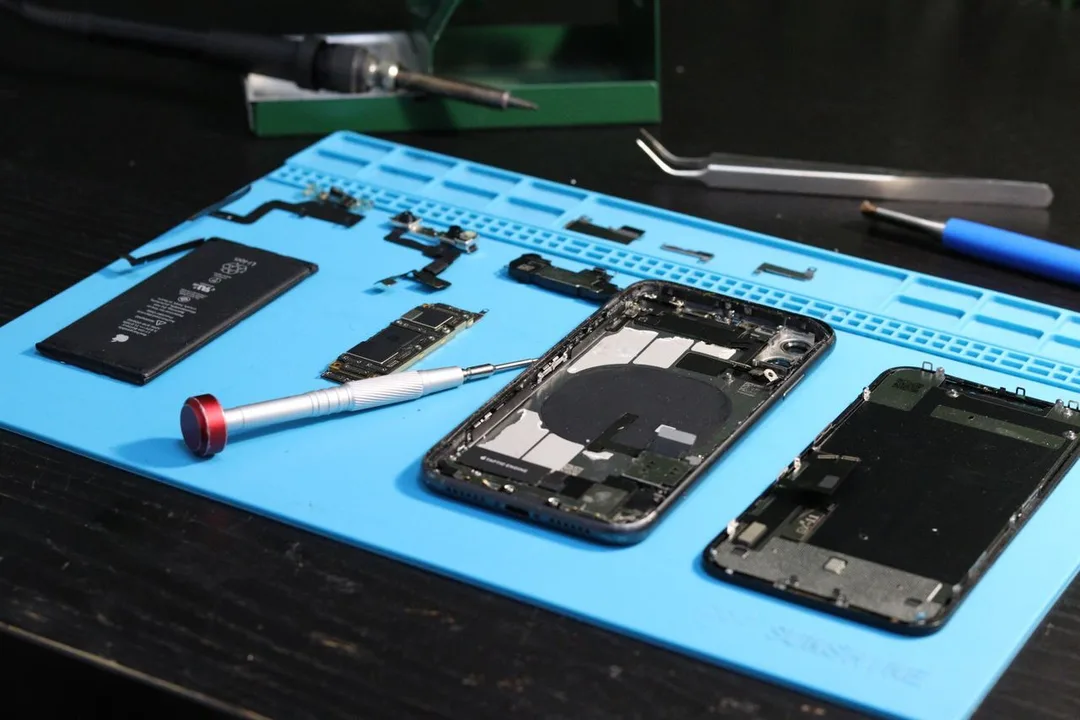
A service counter runs on promises. "Friday." "It's just the charging port." "No, that scratch was already there." Every one of those is a commitment made verbally, at speed, by whoever was free — and every one of them is a dispute waiting to happen, or a phone call you will take three times.
This turns each of those promises into a record: what came in and in what condition, what is wrong with it, what it will cost, who approved that, when it is due, why it is late if it is, and who collected it. The customer sees the part that concerns them, on their own phone, without ringing anyone.
In business since
Clients served
ERP projects
Work by referral
"It'll be ready Friday."
Said from memory, by whoever was free, with nothing behind it.
"That scratch was already there."
Their word against a busy counter's. You give in, because the queue is watching.
"I'll check and call you back."
Which means walking to the bench and asking. Three times, for the same customer.
The date comes from your working hours and a policy — not from whoever answered the phone.
The customer watches the repair on their own phone instead of ringing you a third time.
Accessories ticked, damage shot, signature taken — before the device goes anywhere near the bench.
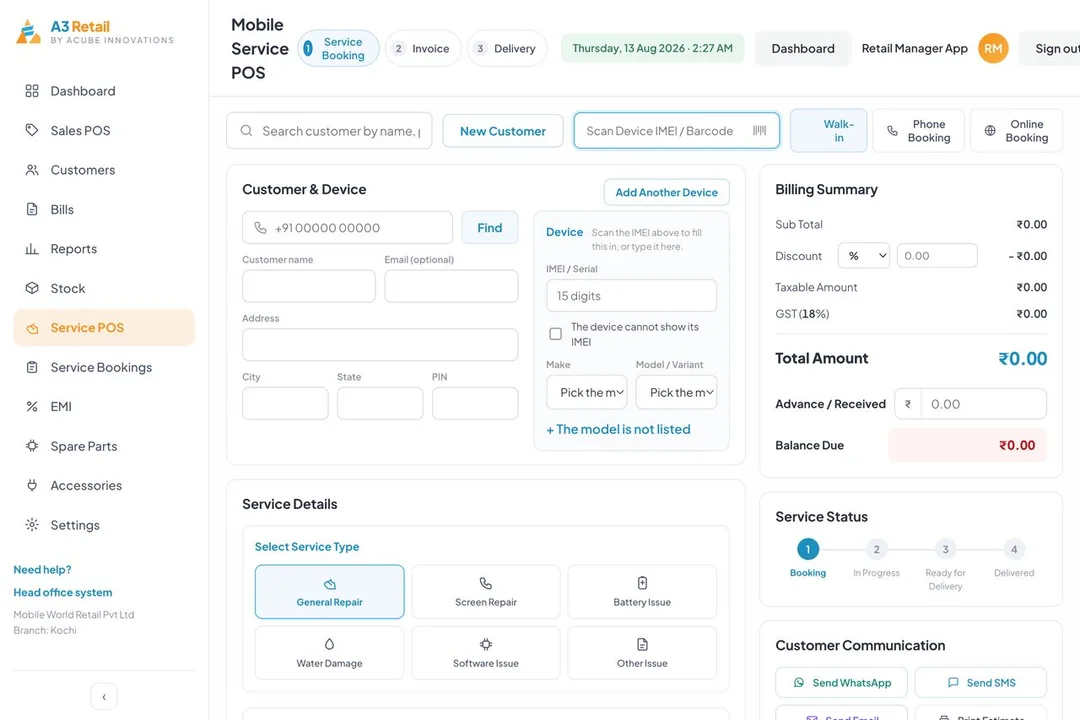
A known number brings up the customer and their history. A new one is created as the name is typed.
If you sold the handset, the system says so and shows the warranty position — so nobody has to ask a customer for a bill they lost a year ago.
Common faults for that model are chips to tap, plus whatever the customer says in their own words.
Tick the accessories handed in, photograph the device front, back and screen-on, and note visible damage. This is the step that settles the argument that has not happened yet.
The data-loss line is read out, and the signature is taken on screen.
A thermal receipt prints, and the customer gets a message with a tracking link.
Their own jobs, in columns by status, with a timer that starts when they begin work.
The fault and root cause are recorded, parts and labour are added, and the estimate goes out for approval.
They approve, reject or ask for a revision on their own phone. The technician sees the answer without chasing anyone.
If the branch is short, the row shows which branch has the part, and a request moves it. The job goes On Hold and the clock stops.
Checked by someone other than the person who did the work, and a failure sends it back to the bench rather than to the customer.
A one-time password goes to the customer's phone. Reception takes the receiver's name, ID reference and signature, collects the balance, and prints the delivery note.
Most turnaround reporting is quietly wrong, and everyone knows it. A flat "48 hours" counts Sunday, counts the four days a part spent in transit, and counts the week a customer took to answer the phone about an estimate. Technicians learn that the number is not about them, and stop treating it as a measure of anything.
Here the clock runs on your working hours, on the days you are actually open. It stops when the job goes On Hold waiting for a part, and it stops while an estimate is with the customer — then starts again by itself. What is left is the time the repair was genuinely yours to control, which is the only version of the number worth managing by.
Not a phone call somebody has to make three times.
Approve, reject, or ask for a revision — and a revision creates a new version rather than overwriting the old one.
So the conversation at the counter is about a record, not about who remembers what.
An estimate nobody answers does not sit open forever pretending the job is live.
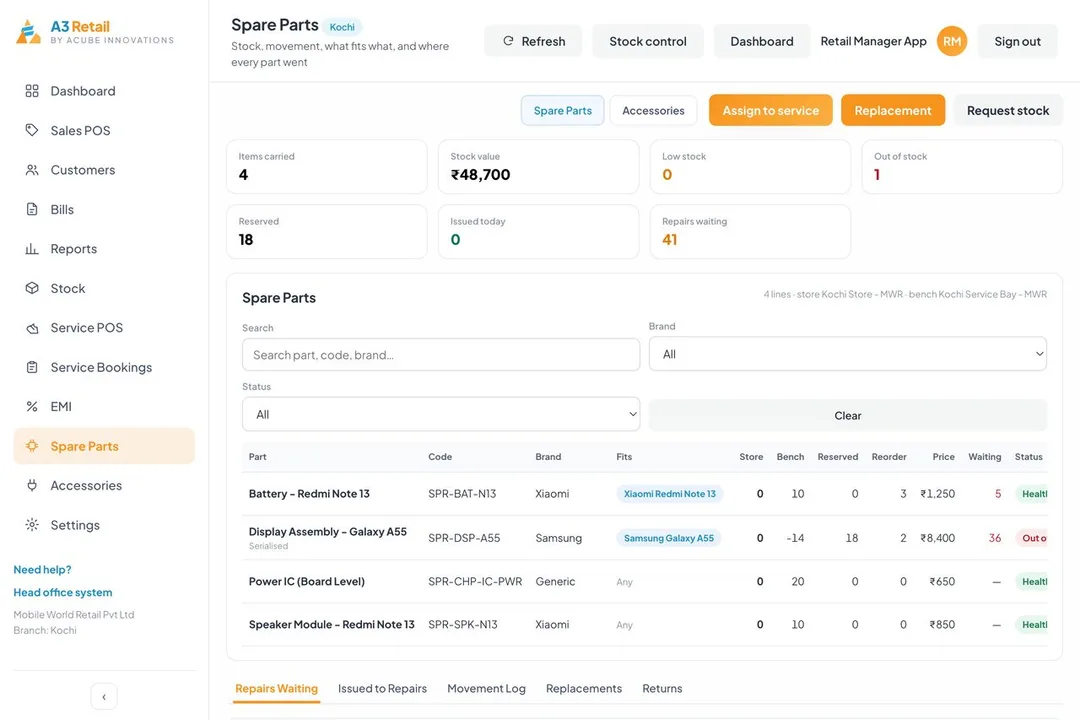
A technician who needs a part should not have to become a procurement officer. The part is added to the job; if this branch does not have it, the row shows which branch does. One press turns that into a request, and the store keeper takes over — approve, dispatch, and the receiving branch confirms arrival. The job's clock pauses across that whole period and resumes on receipt. Meanwhile the Awaiting Parts register is the store keeper's morning list: every job in the chain that is waiting on them, in one place. How stock moves between branches →
The service counter captures the customer, the device and the fault in one pass. Spare parts show what is carried, reserved and waiting on a repair.
, typed in at the counter — so a device is not handed to whoever turns up claiming to be a cousin.
by name and ID reference, with a signature.
, which is what makes a scratch dispute a thirty-second conversation.
against the invoice, and the delivery note prints.
| Report | The question it answers |
|---|---|
| TAT compliance | Are we keeping the promises we make, by branch and by technician |
| Pending job cards ageing | What is old, and how old, before a customer rings to tell us |
| Technician productivity | Jobs closed, time on the bench, and the mix of work |
| Repeat repair analysis | The same device back for the same fault — a warranty and a quality question at once |
| Device model failure analysis | Which models fail, and how, which is a stocking decision for spares |
| Awaiting parts register | Every job in the chain waiting on a part |
| Service revenue and gross profit | What the service side actually earns after parts and labour |
| Warranty versus chargeable mix | How much of the bench is work somebody else is paying for |
Whether a repair is yours to fund, the manufacturer's, an extended plan's or the customer's is answered at intake from the IMEI — before the device is opened and before anyone quotes a price. Where the manufacturer is paying, the claim is raised against the job and chased until the credit or replacement arrives. Warranty and OEM claims →
Bring last month's turnaround numbers and we will show you what a fair version of them looks like.
How it runs today
How it runs on this
Answer a few plain questions about how you work.
Yes. Every job comes with a tracking link; after a one-time password check they see the status and the timeline for their own device, and nothing else.
From a turnaround policy for that kind of job, applied to your working hours and days. A device taken in at 7pm on Saturday is not promised for Sunday morning because a flat hour count said so.
No. The job goes On Hold, the clock stops, and it resumes when the part arrives. That is the whole reason the turnaround numbers are usable.
On a private link sent to their phone. They approve, reject or request a revision, and the answer attaches to the job — so nobody is relying on a remembered phone call.
The photographs taken at intake, the accessory checklist and the signature — all attached to the job and visible at handover.
Yes. The device can be identified by make and model by hand, and the IMEI added later once the device is opened or the box is produced.
The workbench shows load by technician, and the Control Tower shows it across the branch — which is how work gets assigned to someone with capacity rather than to whoever is standing nearest.
Both, in one system. That is the point: the handset you sold is recognised by its IMEI when it comes back for repair, with its warranty position already on screen. Billing and POS →
Get a clear plan, an honest timeline, and a fixed scope. Talk to a real expert today — whether or not you work with us.
or write to info@acube.co
Kochi (Kadavanthra & Infopark) · Thiruvananthapuram · across India & overseas · In business since 2011