
Loading…
Loading…
A live command screen per branch, reports that narrow themselves to whoever opens them, and an incentive run posted straight to payroll.
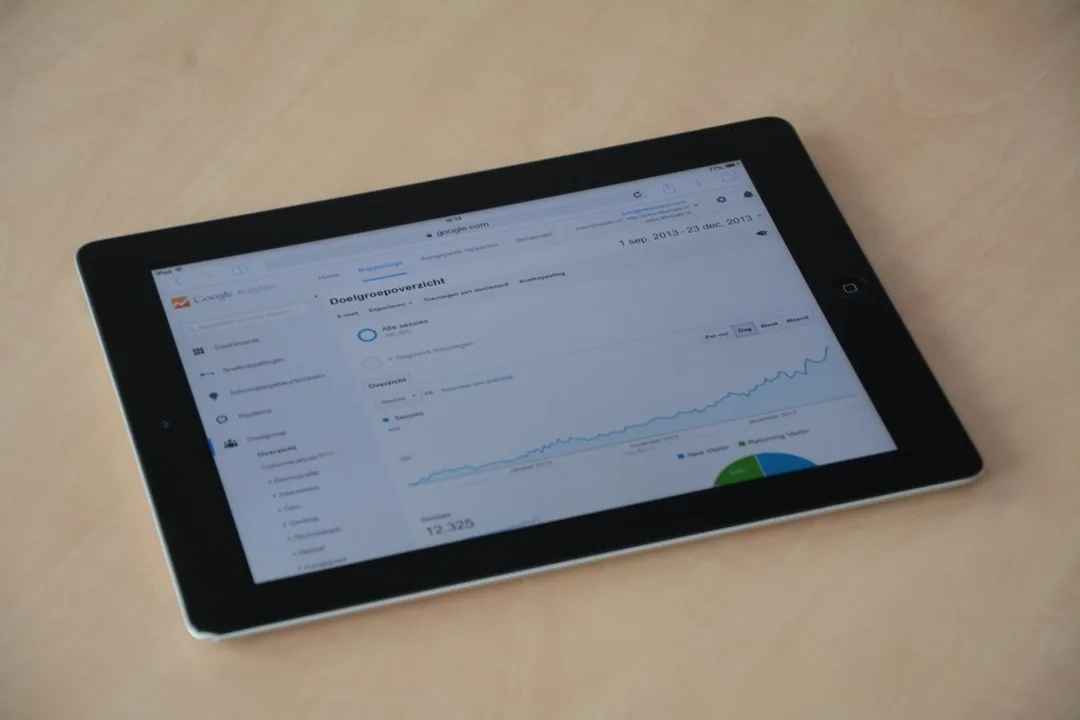
Reporting in most chains is retrospective and contested. The numbers arrive late, they come from different places, and when they disagree the meeting is spent deciding which one to believe rather than what to do.
Two things fix that, and they are the same thing underneath. The numbers have to come from the transactions themselves rather than from a re-keyed summary. And each person has to see the version that is correct for them — a branch manager and a director running the same report should get different answers, and both should be right.
In business since
Clients served
ERP projects
Work by referral
The numbers disagree.
So the meeting is about which report to believe, not what to do.
The branch P&L does not exist.
Not really. Someone would have to spend two days building it.
The incentive sheet is argued over.
Rebuilt from exports every month, and trusted by nobody who is paid from it.
Today's counters, the jobs past their promised time, who is free and what is blocking work.
The same report narrows itself by branch, so managers can be trusted with real reporting.
One gated run, the working on screen, posted straight to payroll. Nobody rekeys anything.
Taken in, delivered, billed, pending — refreshed as they happen rather than at close of business.
Jobs past their promised time, at the top, where they cannot be missed.
What is blocking work right now, which is the branch manager's actual job for the next hour.
Who is free, who is buried — so the next job goes to someone with capacity.
How this outlet compares with the others today, which changes behaviour faster than any monthly review.
A per-outlet profit and loss is normally either impossible or a two-day exercise, and chains work around it with proxies — revenue per branch, or stock per branch — that leave out the costs.
Here it is a filter. Every posting from every module carries its branch as an accounting dimension, and the branch's own cost centre catches its salaries, rent and overhead. So the branch P&L is not built; it already exists, and clearing the filter gives you the chain. Which means the question "is that outlet actually making money?" has an answer this afternoon.
| Group | What it answers |
|---|---|
| Sales and POS | What sold, where, when, by whom, at what margin, and whether the offer paid for itself |
| Service | Are we keeping our promises, how long things take, who is productive, and which models keep coming back |
| EMI and financier | What was financed, what is stuck, what is owed to us, and whether the schemes are worth their subvention |
| Warranty | What is covered, what claims cost, how much of the bench somebody else funds, and what the OEM has not returned |
| Stock and branch | What is where, what is moving, what is not, what was lost, and what each branch earns |
| People | Attendance, incentive payouts, telecalling productivity, and who holds which company asset |
| Compliance and customer | Reverse charge, margin scheme, footfall and conversion, SLA compliance and message delivery |
Grouped by the question you are asking rather than by the module that happens to own the data.
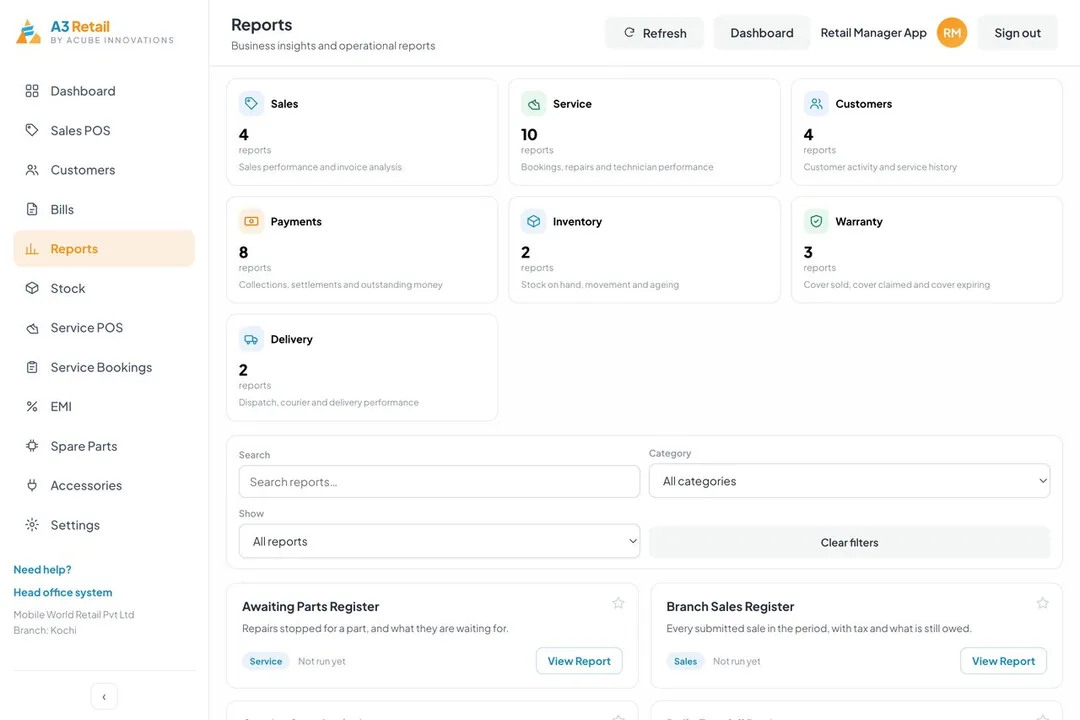
Every one of the fifty narrows itself to the branches the person running it is entitled to see. There is not a branch-manager copy and a head-office copy of each report drifting apart — there is one report that behaves correctly for whoever opens it.
That sounds like a permissions detail. In practice it is what makes it safe to give branch managers real reporting at all, which is the difference between a chain where head office does the analysis and one where each branch manages itself.
Who it covers, the metric, the slabs, the product spiffs, and any scheme-level bonus.
One run per scheme per month, from the transactions — not from an export somebody assembled.
Attendance at or above 90%, customer rating at or above 4.0, returns clawed back. A gate failure means the slab pays nothing, and the spiffs still pay.
The working is on screen, including the gate column, so a disagreement is settled by looking rather than by arguing.
As a line on that month's payslip. Nobody rekeys anything.
| What it does | |
|---|---|
| Slab | The main payout, banded on the metric — value sold, jobs closed, conversions — against the target on the scheme |
| Per-employee target | An override where one person's target genuinely differs from the scheme's headline |
| Product spiff | A fixed amount on specific items, brands or groups — for shifting what you need to shift |
| Scheme bonus | A one-off for a threshold, such as a branch attach rate above a set percentage |
| Attendance gate | Below the threshold, the slab pays nothing |
| Rating gate | Customer satisfaction below the threshold, likewise |
| Returns clawback | What came back is deducted from what was sold |
The gates are the part worth arguing about before you launch, not after. They exist so that an incentive rewards good business rather than volume at any cost — but they only work if everyone understood them in advance, which is why they are on the run for the person to see.
Ten scheduled reports ship ready to be enabled — deliberately switched off until the recipient lists are right, because the fastest way to make people ignore reporting is to send them a daily email they did not ask for.
Bring it along — it is usually the quickest thing to put right.
How it runs today
How it runs on this
Answer a few plain questions about how you work.
Yes. New reports are written against the same permission rules, so they narrow themselves by branch like the rest. That consistency is the reason they are written rather than assembled in a spreadsheet.
By configuration. The usual setting is that they see their own branch's detail and the comparative strip — enough to know where they stand, without exposing another manager's numbers.
Live, with a short cache on the cross-branch comparison strip so that a busy Saturday does not turn every manager's open dashboard into load on the database.
Yes — an approved run creates the additional salary lines for that month, so the payout appears on the payslip without anyone retyping it.
Look at the run. Slab, spiffs, bonus and each gate are shown per person, so the disagreement is about a rule, which is a conversation worth having, rather than about arithmetic, which is not.
Yes, and you should. Sales schemes typically band on achievement against target, service schemes on jobs closed. Both are supported, including whether a slab matches on the raw metric or on percentage achievement.
Usually not at first — the the reports and the dashboards cover the questions most chains actually ask. If you later want to blend this with other sources, Business Intelligence & Analytics is the next step.
Get a clear plan, an honest timeline, and a fixed scope. Talk to a real expert today — whether or not you work with us.
or write to info@acube.co
Kochi (Kadavanthra & Infopark) · Thiruvananthapuram · across India & overseas · In business since 2011