Loading…
Loading…
One system for a chain that sells phones and repairs them — IMEI-accurate billing, repairs the customer can follow on their own phone, EMI that reconciles itself, and live stock across every branch.
Free, no-obligation consult — just a real person.

Official ERPNext Partner
In business since 2011 · 200+ clients
EMI on ERPNext for phone and electronics retail — schemes, document checklists, subvention posting, financier settlement reconciliation and receivable ageing.
ExploreThe full feature list for a mobile retail and service chain on ERPNext — 7 modules, 50 reports, 15 branch screens, 9 customer pages and 24 printed documents.
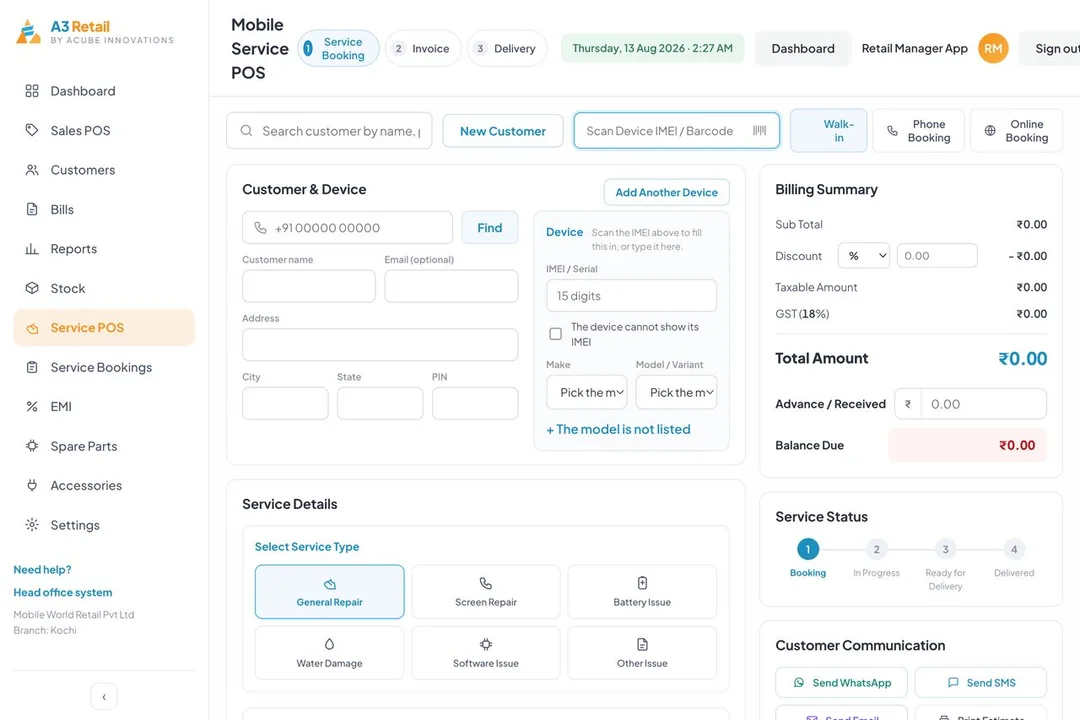
ExploreRepair management for phone service centres on ERPNext — 60-second intake with photos, job cards, a fair turnaround clock, customer-approved estimates and OTP
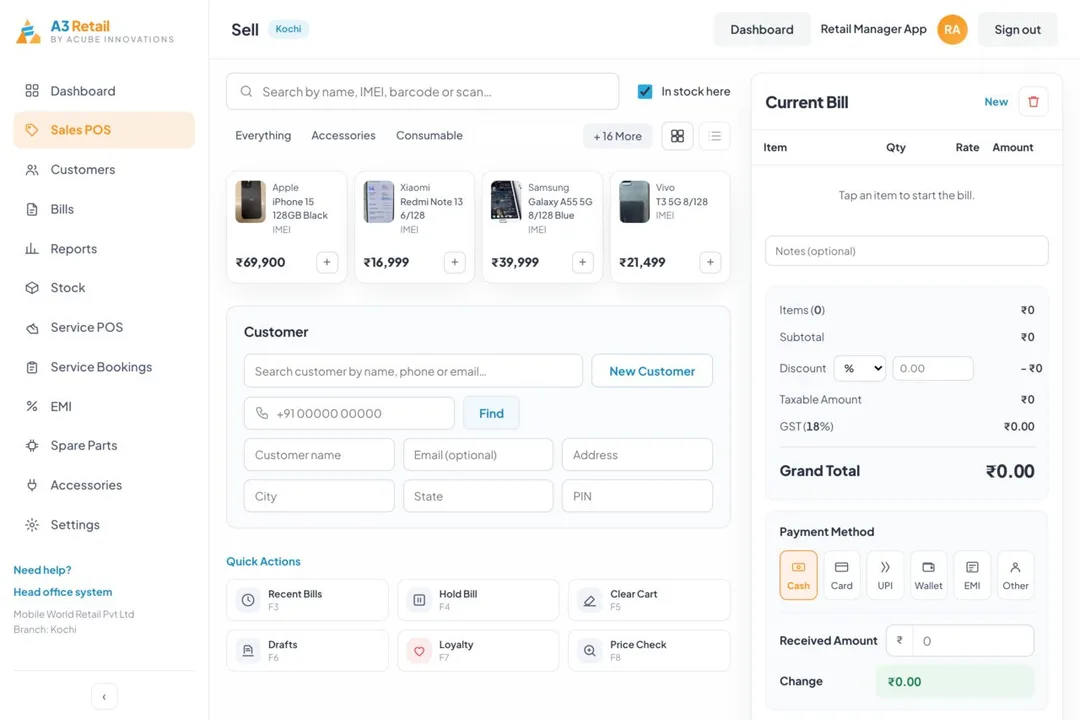
ExplorePOS for phone retail on ERPNext — forced IMEI scan, cross-branch stock at the till, exchange grading, EMI, floor-price guard and GST e-invoice billing.
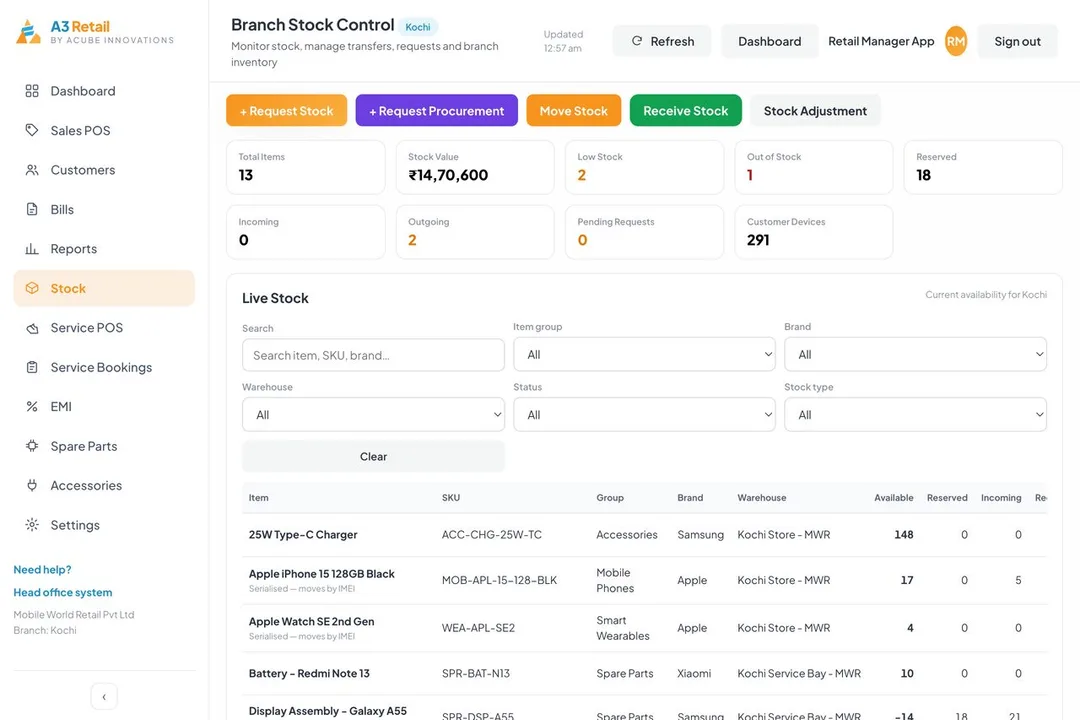
ExploreLive stock across every branch on ERPNext — IMEI-level serial tracking, transfers with an in-transit leg, approval limits, dead-stock rules and branch-wise
ExploreA 45-minute walkthrough on a live system with real data — your workflows, your questions, no slideware. Then a fixed-scope plan, timeline and price.
ExploreThe 14 problems that quietly cost a multi-branch mobile phone chain money — what each one actually costs, and the specific thing that stops it.
ExploreA live branch command centre on ERPNext, 50 branch-aware reports, branch-wise P&L, and incentive runs with attendance, rating and returns gates posted to
ExploreWarranty management on ERPNext for phone retail — coverage answered from the IMEI, extended plans with deferred revenue, claims, and OEM returns chased to the
ExploreCustomer messaging on ERPNext — approved WhatsApp templates, a sender per stream, opt-in and quiet hours, telecalling with dispositions, NPS and SLA
ExploreMost business software treats a mobile shop as a shop. Yours isn't only a shop. Half your counter sells handsets on EMI with an exchange against the old one; the other half takes in devices that are broken, promises them back by Friday, and has to know whether the manufacturer is paying or the customer is. Those two halves share stock, staff, customers and a cash drawer — and almost every system you can buy makes you run them as two businesses that email each other.
This is one system for both, built on ERPNext — so the ledgers, the stock, the GST and the payroll are handled by a platform that already runs thousands of companies, and everything specific to a phone chain sits on top of it. Seven modules, fifty reports written for this trade, and a separate mobile app for the shop floor so counter staff never have to learn an ERP.
In business since
Clients served
ERP projects
Work by referral
The sale walks across the road while the same handset sits unsold at your other branch — and nobody at the counter can see that.
Asked three times, by the same customer, because the only way to find out is to phone the branch and hope a technician picks up.
Or on a photograph in someone's WhatsApp. Or nowhere, which you discover when a warranty claim needs it.
Two months ago. Nobody is quite sure which applications the shortfall relates to.
The festival offer ran a week longer at one outlet, and you found out from the margin.
A spreadsheet nobody fully trusts, rebuilt from scratch every month.
without someone spending two days building one.
| The problem | What it quietly costs | What this does about it |
|---|---|---|
| Every branch is an island | You manage last week's numbers, not today's | Every posting carries its branch, so stock, sales and profit are live per outlet and consolidated in the same click |
| "We don't have that model" | A sale lost to the shop next door, while the stock sits elsewhere | The counter sees every branch's stock for that model and raises the transfer without leaving the screen |
| Repairs go dark | Staff time on status calls, and customers who don't come back | An 18-state job card, a promised time computed on your working hours, and a tracking link the customer opens themselves |
| Handover disputes | Free repairs you didn't owe, and arguments at the counter | Accessories ticked, damage photographed and a signature taken at intake; a one-time password at handover |
| EMI money nobody reconciles | Short payouts that are never chased because nobody can prove them | Every application settled line by line against what the financier actually paid, with ageing by partner |
| Discounting under the floor price | Margin that leaks a few hundred rupees at a time | The till stops a sale below the minimum selling price and waits for a manager |
| Incentives argued over monthly | Trust, and a day of someone's month | One calculation run with the gates applied, visible before approval, posted straight to payroll |
There are fourteen of these in total. Read the full list, with what each one actually costs →
billing that will not let a handset leave without its IMEI, exchange valuation, EMI at the counter and offers that apply the same way in every store. See billing and POS →
intake in about a minute, job cards, a fair turnaround clock, estimates the customer approves on their phone. See service centre management →
EMI schemes, document checklists, subvention and financier settlement that actually reconciles. See EMI and finance →
who pays answered before the device is opened, extended plans, and OEM claims chased to the money. See warranty management →
WhatsApp from the business rather than from a salesperson's phone, telecalling with a queue, and a delivery record. See WhatsApp, CRM and telecalling →
branches, stock transfers with an in-transit leg, courier, damage, dead stock and incentives. See multi-branch stock and IMEI →
the Control Tower, 50 reports and the numbers your branch managers argue about. See reports and incentives →
Captured from a working system with a full dataset behind it — not mock-ups.


The commonest reason an ERP fails in retail is that it was designed for an accountant and handed to a nineteen-year-old at a counter on a Saturday afternoon. So there are two front doors, and which one a person gets is decided by their role, not by a setting somebody can forget.
| The branch app | The ERPNext desk | |
|---|---|---|
| Who | Branch manager, sales, reception, technician, store keeper, telecaller | Accounts, HR, audit, administration |
| On what | A phone or a counter tablet | A computer at head office |
| What they see | 15 screens: sell, book a repair, take payment, check stock, raise a transfer | The full ERP — ledgers, payroll, GST filing, the Control Tower, all 50 reports |
| What they cannot reach | Anything they have no business reaching | — |
| Training | Minutes, because it looks like an app | The usual ERP onboarding, for a handful of people |
| Today | After |
|---|---|
| A billing package per branch, and a stock register beside it | Every till and every store on one live system |
| The IMEI written down, or not written down | A validated register, and the number on the invoice by force |
| Repair status held in a technician's head | A job card with a state, a clock and a customer-facing link |
| EMI files in a drawer, settlements taken on trust | Applications with checklists, settlements matched line by line |
| Warranty claims sent and forgotten | Claims tracked to the credit note, with ageing on what is late |
| WhatsApp from personal numbers, no record | Approved templates, one sender per purpose, every send logged |
| Incentives in a spreadsheet | One gated calculation, posted to payroll |
| Month-end stitched together from branch reports | Branch P&L on demand, because every posting carries its branch |
| This, on ERPNext | A packaged mobile-retail suite | A billing package plus Tally | |
|---|---|---|---|
| Total cost of ownership | 60–80% lower — no per-seat licences | High, and per till | Low, until the chain grows |
| Sell and service together | One system, one customer, one stock | Usually one or the other | Two systems, no link |
| IMEI discipline | Enforced at the till, validated, reportable | Varies | Manual |
| India compliance | GST, e-invoice, reverse charge, margin scheme, payroll | Add-on | Partial |
| Fit to how you work | Open source on Frappe — it bends to your process | You bend to it | You are the integration |
| Ownership | The code is yours, no licence trap | Proprietary | Fragmented |
| Who is accountable | One team, blueprint to support | Vendor plus reseller | You |
The screens above are a running system, not mock-ups. Most of what your chain needs is configuration — your branches, your schemes, your offers, your approval limits — which is why go-live is weeks rather than the year a build from scratch takes.
Written for this trade, so you are not commissioning a reporting project six months after go-live to answer questions you already have today.
Upgrades do not quietly undo your configuration, so the system your staff were trained on in March is the same one they use in December.
A branch manager cannot open another branch's numbers, and a customer's link only ever opens their own document.
The people who configure it are the people who support it, and we scope to a fixed price so you know the number before you commit.
Mobile phone retail chains and franchise networks; consumer-electronics and home-appliance retailers; authorised and multi-brand service centres; brand-exclusive stores; and dealer networks that both sell and repair. It suits a chain of three branches as readily as thirty — and a single busy shop that expects to become a chain. See the wider sector workflows on our Retail & Distribution industry page →
If you sell but do not repair — a supermarket, a fashion or hardware chain — the general Retail POS & Multi-Store Management solution is the better fit.

Official ERPNext Partner
Both, in the order that matters. The platform is already built — the modules, the screens, the reports and the tests exist today. The project is fitting it to your chain: your branches, your schemes, your financiers, your offers and your data. That is why it goes live in weeks rather than the year a from-scratch build takes.
It works for one shop, and it is worth considerably more to a chain. Roughly half the value — transfers, branch profitability, cross-branch stock, incentive gates — only exists once you have more than one outlet. If you are at one shop and heading for three, this is the right time.
Yes, and that is the point of it. The same customer record, the same stock and the same invoice logic serve the sale of a handset and the repair of one. A device you sold is recognised by its IMEI when it comes back broken, and its warranty status is on screen before you ask for the bill.
Not the ERP, no. Counter staff use a separate mobile app with fifteen screens and no ERP concepts in it — and their roles ship with the ERP desk switched off, so they cannot wander into it. Head-office staff who use the desk get the usual onboarding.
It is a web app, so it runs in the browser on a modern Android phone, an iPhone or a counter tablet. There is nothing to install from an app store and nothing to update on each device.
Yes. It runs with the India Compliance app, so GST templates for in-state and out-of-state, e-invoice, HSN codes and reverse charge are handled. Second-hand handsets sold under the margin scheme, Rule 32(5), are handled as their own case with their own register.
Yes. ERPNext and Frappe are open source, and the customisations built for you are yours. There are no per-seat or per-till licences, and no vendor can switch your business off.
Weeks rather than months, because the product exists. What sets the date is the number of branches, how much of your existing data has to be migrated and cleaned, and how far your schemes and offers differ from what is already built. We scope that up front and give you a fixed price before you commit.
Get a clear plan, an honest timeline, and a fixed scope. Talk to a real expert today — whether or not you work with us.
Kochi (Kadavanthra & Infopark) · Thiruvananthapuram · across India & overseas · In business since 2011