
Loading…
Loading…
Every module, every screen, every report — and the print formats behind them.

This is the reference page: everything that exists, grouped the way the system is actually built. If you are deciding whether this fits your chain, the honest way to read it is to look for the two or three things you do that nobody else does, and see whether they are here.
A note on what "module" means. ERPNext underneath already owns the ledgers, the stock ledger, the tax engine, the customer master and payroll — proven, and deliberately not rewritten. The modules below are what a phone chain needs that a general ERP has no name for.
In business since
Clients served
ERP projects
Work by referral
No handset leaves without a scanned, validated serial that matches this branch's stock.
A tracked job card, a turnaround clock on your working hours, and estimates the customer approves.
Schemes, checklists, subvention posted as a cost, and settlements matched application by application.
Cover answered from the IMEI, claims tracked out to the manufacturer and chased until the credit lands.
Cross-branch stock, transfers with an in-transit leg, and a per-outlet P&L that already exists.
Approved templates from the business, with consent, quiet hours and a delivery record.
| Feature | What it does |
|---|---|
| IMEI-forced device lines | A handset cannot be billed without a scanned IMEI. The number is validated and checked against stock actually in that branch |
| Cross-branch availability at the till | Out of stock here shows which branch has it, and raises the transfer without leaving the sale |
| Minimum selling price guard | A line below the floor price stops and waits for a manager's approval |
| Offers applied automatically | Campaign pricing reaches the line by itself, with the applicable offer shown on it |
| Device exchange with grading | The same questions every time, a value that follows from the answers, and the used unit back into stock under its original IMEI |
| EMI at the counter | Scheme, document checklist and financier approval, without leaving the sale |
| Extended warranty prompt | Offered on the bill before printing, and counted on the salesperson's attach rate |
| Salesperson attribution | Every line carries who sold it, which is what makes an incentive calculable |
| Free-item offers | The same item can legitimately appear twice on a bill — a free tempered glass with a handset bills as what it is |
| Feature | What it does |
|---|---|
| Service Job Card | Tracks intake, diagnosis, estimate, repair, hold, QC, ready and delivery as distinct states |
| Turnaround policy | The promise is computed on your working hours and holidays, not a flat 48 hours that ignores a Sunday |
| Clock pause and auto-resume | Time waiting on a part or on the customer's approval does not count against the technician |
| Device model issue library | Common faults per model, so intake is chips to tap rather than a paragraph to type |
| Photographed intake | Accessories checklist, damage photographs compressed in the browser, consent and an on-screen signature |
| Estimates approved by the customer | A private link on their own phone: approve, reject or request a revision, with revisions kept |
| Parts request across branches | Becomes a stock request or a material request, and the store keeper takes it from there |
| Technician profiles and skills | Who is qualified for what, and who is free right now |
| QC before delivery | Checked by someone other than the person who did the work |
| One-time-password handover | The OTP goes to the customer's phone; receiver name, ID and signature are kept with the job |
| Repeat repair analysis | The same device back for the same fault is visible, not anecdotal |
| Feature | What it does |
|---|---|
| Finance partners | Each with its own branch codes, schemes and commercial terms |
| EMI schemes | By brand, item group and tenure, with the subvention you have agreed |
| Document checklist | What this partner needs for this scheme, ticked before submission |
| Subvention posting | The cost you carry is posted as a cost, not lost inside the sale price |
| Financier settlement | What arrived against what was expected, per application |
| Receivable ageing by partner | Who owes you what, and for how long |
| Conversion funnel | Applications started, approved, rejected and cancelled — by scheme and by branch |
| Feature | What it does |
|---|---|
| Warranty registration | Tied to the IMEI at the point of sale, so coverage is a lookup rather than a search for a bill |
| Coverage items | What a plan actually covers, so the counter answer is consistent |
| Extended warranty plans | Sold as a product, with the revenue recognised across the term rather than all on day one |
| Warranty claim log | Every claim against the job that generated it |
| OEM warranty returns | Devices and parts tracked out to the manufacturer, and chased until the credit or replacement comes back |
| Renewal reminders | Cover about to expire becomes a call list rather than a lapse |
| Feature | What it does |
|---|---|
| Branch profiles | Creating a branch creates its warehouses, its cost centre and its accounting dimension — you do not wire it up by hand |
| Stock requests with an in-transit leg | Stock leaves the sending branch on dispatch and joins the receiving branch on receipt. It is never in two places, and never in none |
| Approval limits | Transfers above a value wait for a branch manager |
| Stock damage reports | Photographed, attributed, and recovery from an employee routed through payroll |
| Demurrage charges | Storage billed for devices left uncollected past a grace period |
| Dead-stock rules | Ageing thresholds that flag slow stock while it still has value, with provisioning |
| Courier partners and rate cards | Zones derived from the pincode, dispatches tracked, and delays scanned for |
| Feature | What it does |
|---|---|
| Sender profile per stream | Sales, service, EMI, warranty, helpdesk and marketing each send from their own number and token |
| Approved templates | Written once, approved by Meta, and used consistently |
| Communication rules | An event on a document triggers the right message, without anyone remembering to send it |
| Consent, quiet hours and a daily cap | Marketing must clear all three. Utility messages about a customer's own device always go |
| Delivery log | Sent, delivered, read or failed, with the reason |
| Telecalling campaigns | A generated list, a queue for the day, the customer's history beside the dial button |
| Dispositions and DNC | Every call ends in an outcome, and "do not call" removes the number from every future campaign |
| Feedback and NPS | A rating of 2 or below opens a ticket by itself and notifies the branch manager |
| Helpdesk SLA ladder | Breaches escalate agent to service manager to branch manager to head office |
| Feature | What it does |
|---|---|
| Geofenced check-in | Attendance marked at the branch, with a documented exemption for staff who legitimately work away |
| Incentive schemes | Slabs on the metric that matters, plus product spiffs, plus scheme-level bonuses |
| Three gates | Attendance, customer rating and returns clawed back. A gate failure means the slab pays nothing, and the spiffs still do |
| Calculation run | One run per scheme per month, checkable before approval |
| Post to payroll | The result becomes a payslip line for that month. Nobody rekeys it |
| Asset custody | Test devices and tools are held in a person's name |
| Exit clearance | An employee cannot be marked as left while an asset is still with them |
the intake screen: customer by mobile number, IMEI scan, complaint chips, accessory checklist, camera capture with in-browser compression, consent and signature, and a printed receipt at the end.
a board of the technician's own jobs in columns by status, with a work timer that starts when they begin and pauses when a job goes on hold.
one model, every branch's stock, and a transfer request in a click.
the branch manager's live screen: today's counters, red rows past their promised time, the parts position, technician load, and a strip comparing branches.
From a working system with a full dataset behind it. Selling, taking a repair in, branch stock, spare parts, EMI and the report library.
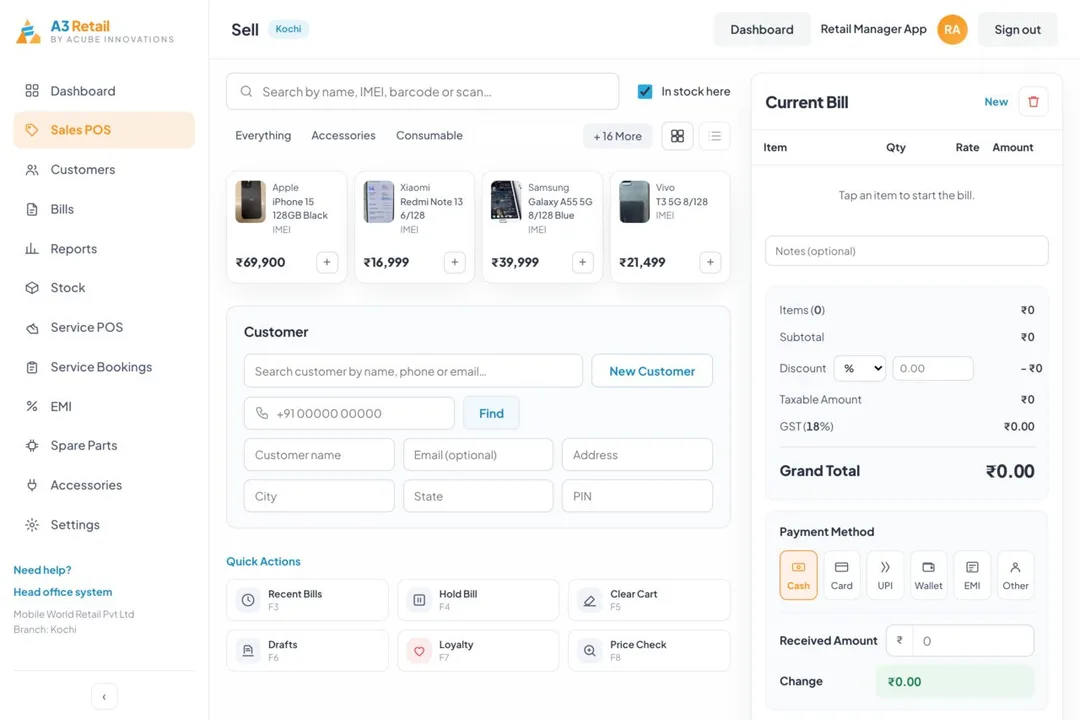
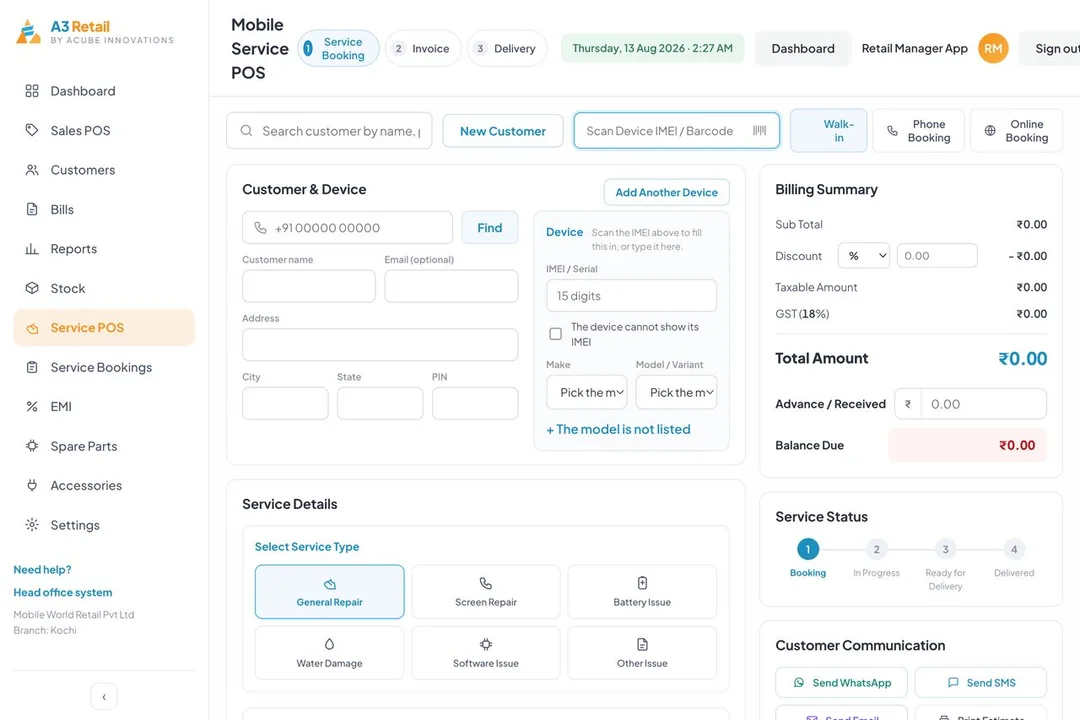
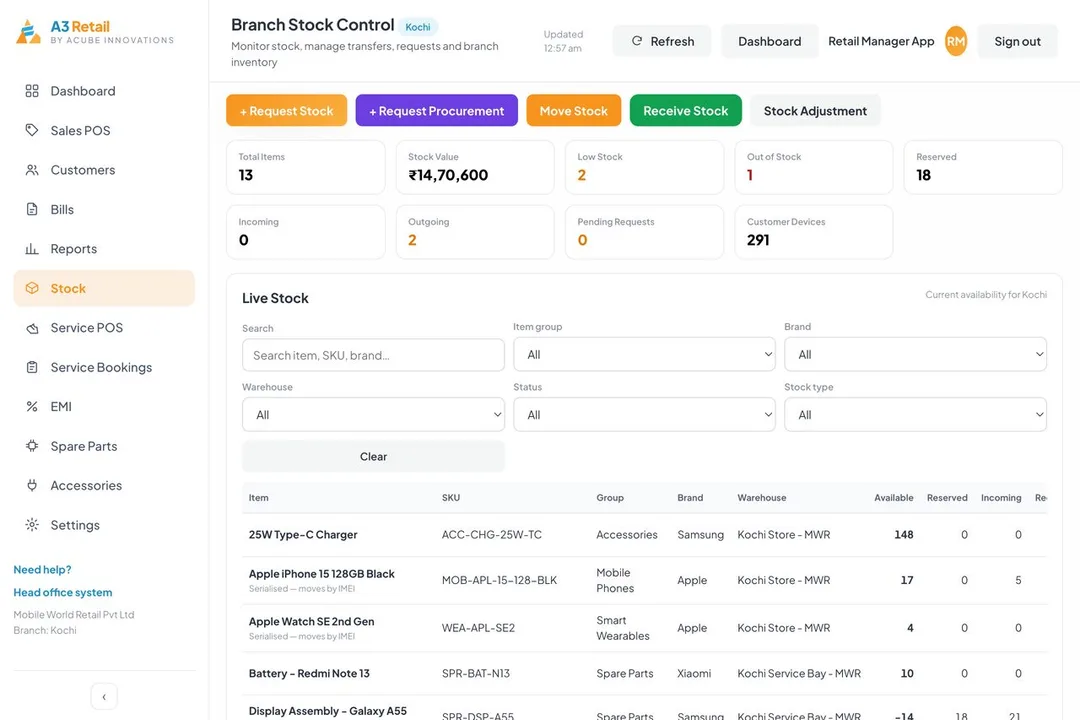
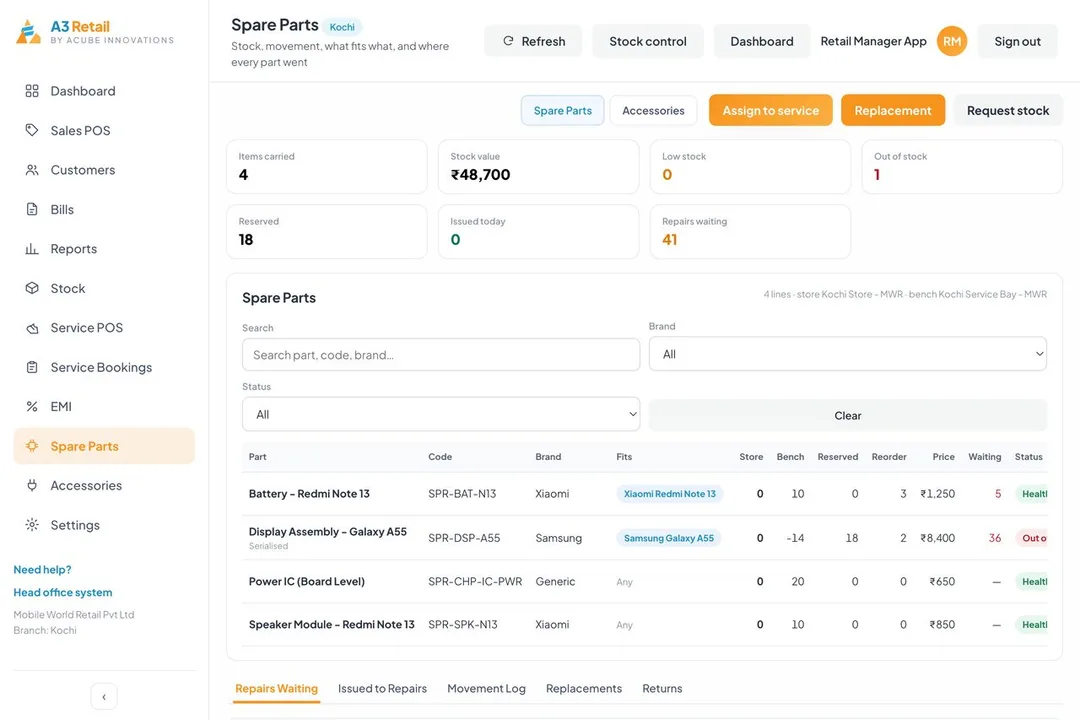
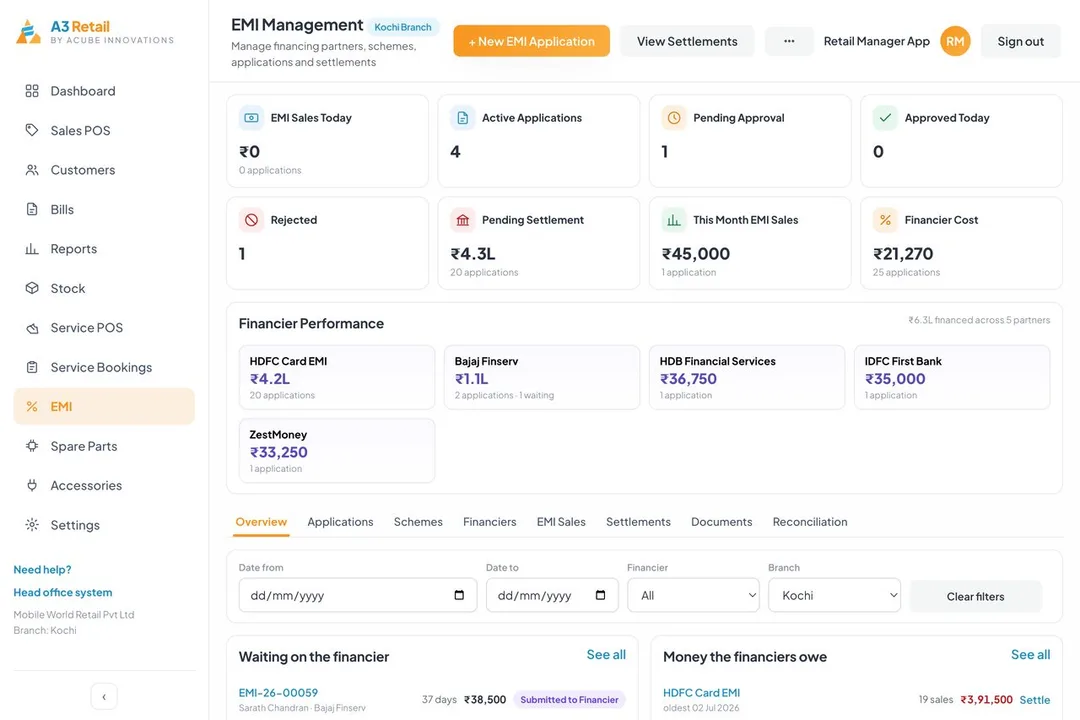
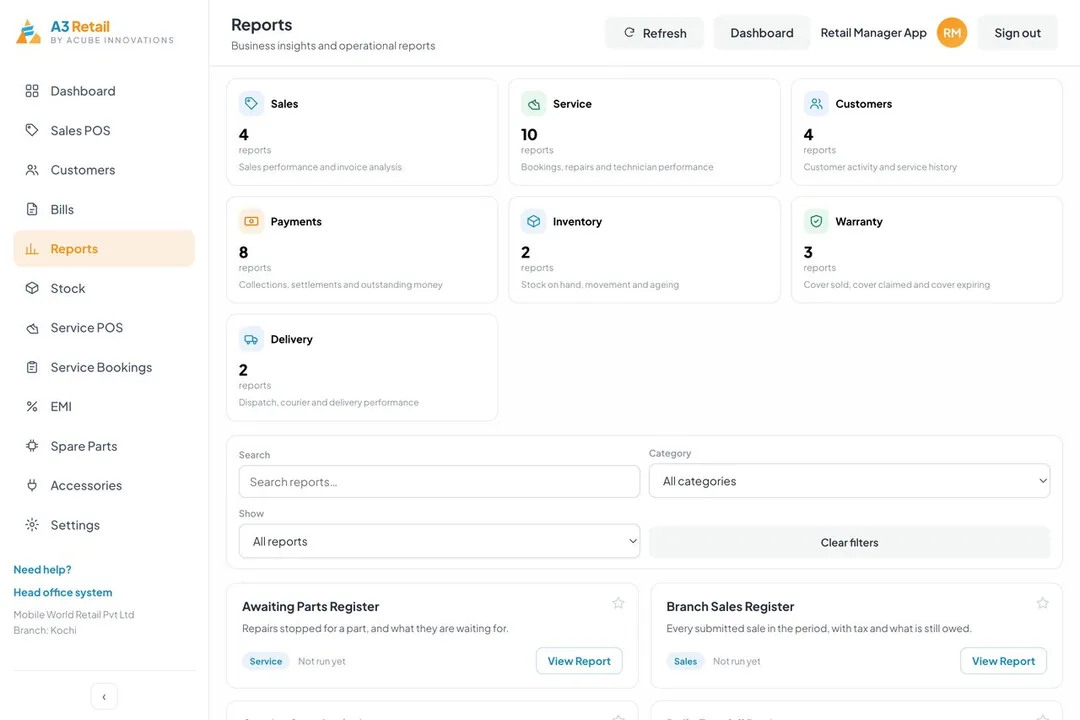
Shop-floor staff never open the ERP. They get a separate mobile web app with its own design, covering: dashboard (your branch's numbers, and what needs you today), sales, service counter, bookings, bills, customers, EMI, stock, parts, reports and invoices. Their roles ship with ERP desk access switched off, and it is switched off again on every upgrade.
Each page is reached by a private link that proves the customer is entitled to that document — nothing to remember, nothing to log into.
| Page | What it does |
|---|---|
| Track service | The repair's status and timeline, after a one-time password check |
| Approve estimate | Approve, reject or ask for a revision |
| Warranty certificate | The certificate, downloadable |
| Pay online | UPI or card for what is due, reconciled back to the invoice automatically |
| Invoice | The tax invoice as a PDF |
| Raise a complaint | Opens a ticket after a one-time password check |
| Feedback | Stars, NPS and comments |
| Offers | What is currently running |
| Stores | Addresses, opening hours and directions |
Not a report builder and a wish. They exist on day one, and each narrows itself to the branches the person running it is allowed to see — so a branch manager and a director run the same report and get correct, different answers.
| Group | What is in it |
|---|---|
| Sales and POS | Branch sales register, IMEI sales register, hourly POS heatmap, salesperson performance, offer effectiveness, exchange register |
| Service | Daily service register, TAT compliance, pending job cards ageing, technician productivity, repeat repair analysis, device model failure analysis, awaiting parts register, service revenue and gross profit |
| EMI and financier | Application register, pending approval, conversion funnel, scheme performance, financier performance, receivable ageing, outstanding settlement, settlement reconciliation, commission and subvention, salesperson EMI sales, cancellation register |
| Warranty | Warranty register, claim cost, warranty versus chargeable mix, extended-warranty attach rate, expiring warranty upsell list |
| Stock and branch | Branch stock summary, cross-branch availability, stock transfer register, stock ageing and dead stock, damage and loss register, courier cost analysis, branch profitability statement |
| People | Attendance register, incentive payout register, asset register by branch, telecalling productivity |
| Compliance and customer | RCM liability and ITC register, margin scheme register, daily footfall register, footfall conversion analysis, helpdesk SLA compliance, WhatsApp delivery report, delivery delay report |
Grouped by the question you are asking rather than by the module that owns the data.
Every document a counter actually hands over, laid out properly and printed on the right paper — thermal for receipts, A4 for the rest, each on the letterhead of the branch that issued it.
Thermal job-card receipt and POS receipt; retail and service tax invoices; service estimate; device delivery note; device exchange receipt; extended warranty card and warranty certificate; EMI application form and document checklist; financier settlement statement; advance receipt; payment receipt; stock transfer note; delivery challan; gate pass; courier manifest; stock damage report; asset custody acknowledgement; purchase order; quotation; RCM self-invoice; salary slip. QR codes, UPI payment strings and e-invoice IRNs are generated onto them where they belong.
in-state and out-of-state templates, HSN codes at the six or eight digits the law actually requires, and consolidated or branch-wise books.
IRN and QR on the invoice, through the India Compliance app.
posted as the add-and-deduct pair, so the liability and the input credit both appear and net correctly.
second-hand handsets taxed on the margin rather than the sale value, with their own register to support it.
categories configured, deducted where they apply.
PF, ESI, professional tax and TDS through the HRMS app, with salary landing in the branch's own cost centre.
Bring the two or three things you do that nobody else does — that is the interesting part of the conversation.
What the demo coversAnswer a few plain questions about how you work.
Yes — this is what exists, not a roadmap. What varies by project is configuration: your schemes, your offers, your approval limits, your templates and your branches.
Yes. It runs on the Frappe framework, so new record types, fields, reports, roles and integrations are ordinary work rather than a licensing negotiation — and what is built for you is yours. ERPNext Customisation →
No. Most chains start with the two or three that hurt most — commonly service and stock — and add the rest once the first go-live has settled.
Yes. The fifty are a starting point that covers the usual questions; new ones are written against the same permission rules, so they narrow themselves by branch like the rest.
Scanners behave as keyboards, which is what the IMEI and item fields expect. Thermal formats are built for standard receipt printers. We confirm your specific models during scoping rather than assuming.
Available as a separate capability we deliver on Zebra hardware, and worth considering once the stock volume makes counting the bottleneck. RFID Solutions →
A person's role decides what they can open, and their branch decides which records they can reach at all — a branch manager cannot see another branch's customers. Links sent to a customer are signed, so a customer can only ever open their own document and never anybody else's.
No — it needs a connection. We would rather say so plainly than have you discover it on a Saturday evening. Where connectivity is genuinely unreliable, the usual answer is a backup connection at the branch, and we will tell you that during scoping rather than after.
Get a clear plan, an honest timeline, and a fixed scope. Talk to a real expert today — whether or not you work with us.
or write to info@acube.co
Kochi (Kadavanthra & Infopark) · Thiruvananthapuram · across India & overseas · In business since 2011