
Loading…
Loading…
Separate stock and separate profit per branch, one live view across the chain, and a transfer that only leaves your books when the other branch actually receives it.

The moment you open a second outlet, stock stops being a thing you can see and becomes a thing you have to be told about. And the way most chains are told about it — a message, a shared sheet, a call to the other manager — is exactly good enough to feel like control and not good enough to act on.
This makes the whole chain's stock one live picture, down to the individual handset, while keeping each branch's numbers genuinely its own.
In business since
Clients served
ERP projects
Work by referral
Where that handset actually is.
One branch is sure they sent it. The other is sure it never arrived.
Which model is dying quietly.
Slow at one shop, out at another — and you find out at the markdown.
What each branch really earns.
The number exists. Building it takes somebody two days.
Search a model and see who has it — from the counter mid-sale, or from head office.
Stock leaves on dispatch and arrives on receipt. In between it belongs to nobody and is still visible.
Every posting carries its branch, so per-outlet profit is a filter rather than a two-day exercise.
Its warehouses, its cost centre and its accounting dimension are created with it, and named consistently. Nobody wires this up by hand, which is where most chains' reporting quietly diverges.
A sale, a repair, a payment, a payroll line — the dimension goes on automatically, so nothing has to be classified afterwards.
A user's employee record decides which branch's documents they can open, and refusing another branch's document by name is enforced rather than trusted.
Clear the filter and you are looking at the chain. There is no separate group reporting exercise, because there was never more than one set of books.
One model, every branch's stock, on one screen — from the counter during a sale, or from the Stock Explorer at head office.
One press turns that row into a transfer request to the branch that has it.
The sending branch approves and dispatches. The stock leaves their books at that moment, so their count is honest immediately.
It becomes the receiving branch's stock only when they confirm receipt — and only then can they sell it. Between those last two steps the stock is genuinely in transit: counted, visible, and belonging to neither branch. That sounds like a technicality until you have spent an afternoon looking for four handsets that one branch is sure they sent and the other is sure they never got.
The check digit is verified when a handset is received, so a mistyped number is caught at the door rather than at a warranty claim.
The till will not complete a device line without one, matched against stock in that branch.
Genuinely mis-printed boxes exist. Overriding the check is an administrator's action and it is recorded, rather than being a habit anyone can fall into.
Which unit, which invoice, which customer, which branch — including when it comes back for repair years later.
Transfers below a value go through on the branch manager's own authority; above it they wait for approval. The point is not bureaucracy — it is that a chain where anyone can move anything develops a slow, untraceable drift of stock towards whoever asks most often. A limit turns that into a decision somebody makes on purpose.
| What happens | |
|---|---|
| Ageing and dead stock | Rules flag slow-moving stock while it still has value, with provisioning, rather than at year end when it has none |
| Damage reports | Photographed, attributed, and recovery from an employee routed through payroll rather than forgotten |
| Demurrage | Storage charged on devices left uncollected past a grace period, so your shelf is not free warehousing |
| Write-offs | A decision with a record and an approver, not an adjustment somebody made |
Where stock moves by courier rather than by hand, partners and rate cards are configured, the zone is derived from the destination pincode, dispatches are tracked, and a scheduled scan flags consignments that are late. The Courier Cost Analysis report then answers the question most chains cannot: what this movement actually costs you per branch, per month.
what is where, by branch and category.
one model across the whole chain.
everything moved, including what is in transit right now.
what is going slowly, while there is still time to act.
what was lost, how, and what was recovered.
the real cost of moving stock around.
the P&L per outlet, which exists because every posting carried its branch.
What this branch holds, what is incoming and outgoing, what is reserved, and the transfer and procurement actions in one place.
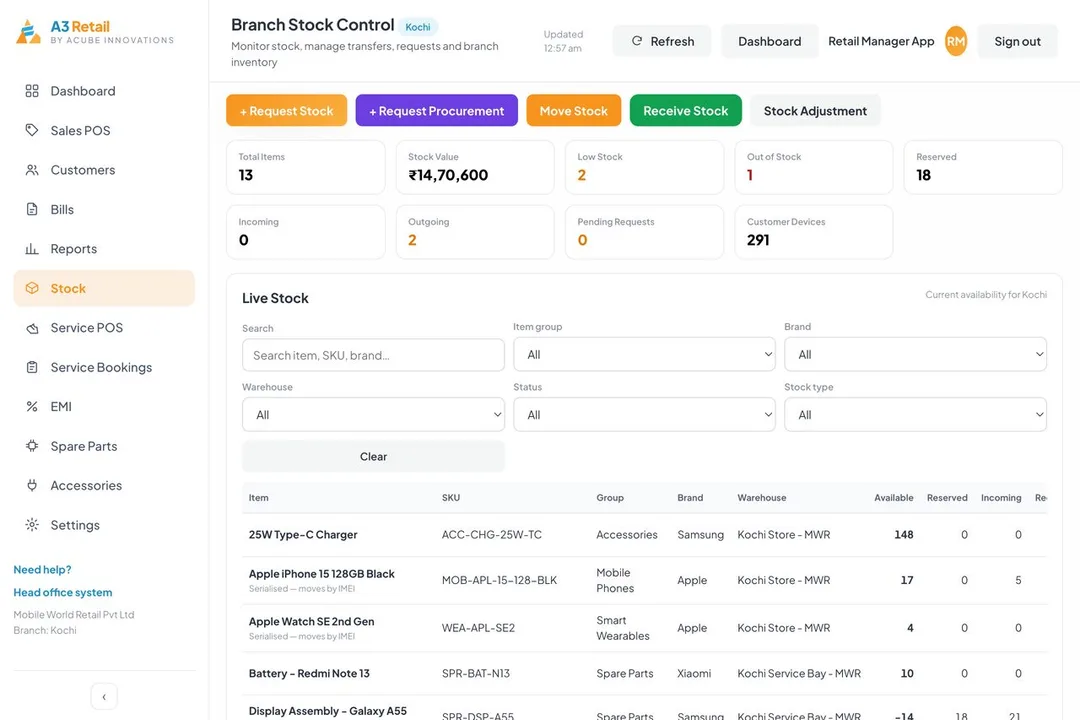
Bring the last transfer that went missing — it is usually the fastest way to show what changes.
How it runs today
How it runs on this
Answer a few plain questions about how you work.
No, and you should not. One company, one set of books, with each branch as a warehouse, a cost centre and an accounting dimension. That gives per-branch profitability without the tax and reconciliation burden of separate entities.
Yes — that is the usual configuration. Cross-branch availability is what makes a transfer possible, while sales, margin and customer data stay scoped to the branch the user belongs to.
It belongs to neither branch. It has left the sender's books and has not joined the receiver's, so it cannot be sold twice or assumed by both — and it is visible on the transfer register the whole time.
It happens. An administrator can override the check for that unit, and the override is recorded against the transaction so a pattern of overrides is visible rather than invisible.
Counts run against the system's expected position by branch and warehouse, and differences post as adjustments with an approver. For chains where counting has become the bottleneck, RFID-based counting is worth considering. RFID Solutions →
Yes. Creating the branch profile creates its warehouses, cost centre and dimension, so a new outlet is a configuration task rather than a project.
Yes — spares, accessories and used devices are all stock, in their own warehouses, and the service side draws parts from them through the same transfer mechanism.
Get a clear plan, an honest timeline, and a fixed scope. Talk to a real expert today — whether or not you work with us.
or write to info@acube.co
Kochi (Kadavanthra & Infopark) · Thiruvananthapuram · across India & overseas · In business since 2011